
Digital Transformation
Enterprise Architecture
Framework
Deep analysis for enterprise leaders navigating digital transformation, governance, and sustainable execution.

Artificial intelligence has moved beyond experimentation. Today, nearly every enterprise is exploring AI initiatives to improve efficiency, reduce costs, strengthen decision-making, and create competitive advantage. Yet despite billions invested globally, many organisations remain stuck in the same place: endless pilots, disconnected tools, and proof-of-concept projects that never scale.
The reason is surprisingly simple. Most enterprises treat AI roadmaps as technology programmes instead of operational transformation strategies.
They focus heavily on vendors, infrastructure, and use cases while overlooking the structural decisions that determine whether AI becomes sustainable or collapses under operational complexity. Building an AI Roadmap for Your Organisation requires far more than selecting the right model or platform. It demands accountability, governance, adoption planning, risk management, and measurable business alignment.
After more than three decades of enterprise programme leadership across digital transformation initiatives, one pattern remains consistent: organisations that succeed with AI make a small number of critical structural decisions early. Those that fail delay those decisions until problems emerge.
This article explores where most enterprises get AI roadmaps wrong — and the five foundational decisions that separate scalable AI programmes from stalled innovation theatre.
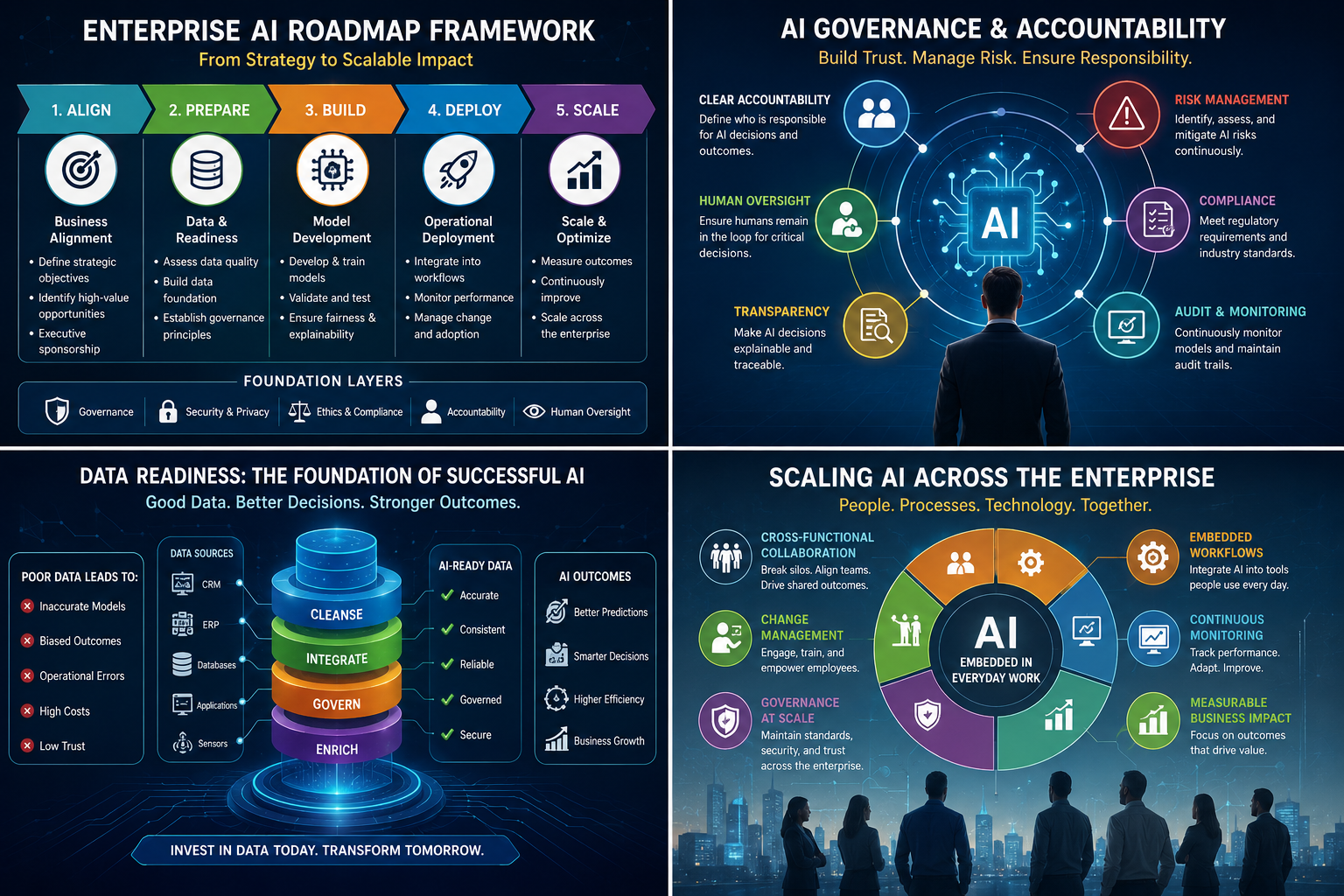
Many AI programmes begin with excitement. Leadership teams announce innovation initiatives. Vendors demonstrate impressive capabilities. Data science teams build promising prototypes. Early results look encouraging.
Then momentum fades.
Projects struggle to move into production. Teams disagree on ownership. Risk and compliance departments intervene late. Employees resist adoption. Data quality issues emerge. Costs increase without measurable business outcomes.
This cycle repeats across industries because many organisations misunderstand what an AI roadmap actually is.
An AI roadmap is not simply a timeline of technology deployments. It is an enterprise operating model for decision intelligence.
Without structural alignment, AI remains trapped in experimentation.
According to McKinsey & Company, many organisations fail to generate measurable returns from AI because they underestimate operational integration and governance complexity. Successful AI transformation requires business redesign, not just technical implementation.
The most dangerous assumption enterprises make is believing technical capability automatically creates organisational value.
It does not.
Many executives unintentionally confuse AI strategy with vendor selection.
A roadmap filled with cloud providers, machine learning platforms, implementation phases, and automation targets may appear sophisticated. However, if it does not define operational accountability and governance structures, it is simply a procurement document.
True AI strategy answers deeper organisational questions:
These questions are often ignored because they are harder than selecting technology.
Unfortunately, they are also the questions that determine programme survival.
Enterprises frequently mistake activity for progress.
Launching pilots across departments creates the appearance of innovation. However, disconnected experiments often generate fragmented systems, duplicated costs, inconsistent governance, and conflicting priorities.
Without enterprise-wide standards, AI becomes difficult to scale.
This explains why many organisations maintain dozens of AI pilots while achieving little operational transformation.
Use cases matter, but they are not enough.
Many AI roadmaps list applications such as:
While useful, these examples do not explain how AI integrates into enterprise decision-making frameworks.
The roadmap must define the system surrounding the technology.
That system is what determines scalability.
One of the biggest mistakes enterprises make is deploying AI without clear accountability structures.
When systems produce inaccurate outputs, who is responsible?
The answer is often unclear.
AI introduces a dangerous operational grey area where decisions become partially automated but accountability remains undefined. This creates governance confusion, legal exposure, and operational hesitation.
Successful organisations define accountability before deployment begins.
AI cannot remain isolated inside IT or innovation departments.
Enterprise-wide transformation requires executive ownership across:
Without executive alignment, AI programmes become fragmented.
Strong governance begins at leadership level.
Every AI system eventually produces errors.
Models drift. Data changes. External conditions evolve. Bias emerges. Predictions fail.
Mature enterprises prepare for this reality early.
A scalable AI roadmap includes:
If accountability is unclear during failure scenarios, operational trust collapses quickly.
Governance is often treated as a later-stage activity.
This is a serious mistake.
Governance must exist from the beginning because retrofitting controls after deployment becomes expensive and disruptive.
AI governance includes:
Without governance, scaling AI becomes dangerous.
AI systems are not static.
Over time, input data changes. Customer behaviour shifts. Market conditions evolve. This causes model performance degradation, known as model drift.
Without monitoring systems, organisations may continue relying on inaccurate predictions for months before noticing performance decline.
Effective AI roadmaps include continuous monitoring frameworks from day one.
Global AI regulation is expanding rapidly.
Governments increasingly demand:
Enterprises that delay governance preparation may face significant compliance risks later.
Organisations should monitor emerging frameworks from groups like the European Commission AI Act to stay prepared for evolving regulatory expectations.
Many enterprises obsess over advanced models while ignoring poor data foundations.
This is one of the most expensive mistakes in AI transformation.
Even the most sophisticated AI system fails when trained on incomplete, inconsistent, or unreliable data.
Data readiness matters more than algorithm complexity.
Enterprise data environments are often fragmented.
Different departments maintain separate systems, conflicting definitions, duplicated records, and inconsistent standards.
As a result:
Before scaling AI, organisations must first improve:
Poor data quality creates invisible operational costs.
Teams spend excessive time:
Many failed AI initiatives are actually failed data programmes disguised as AI projects.
Technology alone never transforms organisations.
People do.
One of the most overlooked elements in Building an AI Roadmap for Your Organisation is operational adoption planning.
Employees must trust, understand, and integrate AI into daily workflows.
Without adoption, even technically successful systems fail commercially.
Employees often resist AI for understandable reasons:
Ignoring these concerns creates silent resistance.
Successful enterprises invest heavily in:
AI adoption is ultimately a behavioural transformation challenge.
AI should enhance workflows, not complicate them.
The best enterprise AI systems feel invisible because they integrate naturally into existing operations.
Examples include:
Adoption increases when AI complements familiar processes.
Many enterprises track the wrong metrics.
Technical teams often focus on:
While important, these metrics do not guarantee business value.
Executives care about outcomes.
A model with 95% accuracy may still fail commercially if it:
Effective AI roadmaps connect directly to measurable business outcomes such as:
Business value must remain the primary success metric.
Several recurring mistakes repeatedly undermine enterprise AI programmes:
| Mistake | Impact |
|---|---|
| Treating AI as an IT initiative | Weak business adoption |
| Starting with technology instead of problems | Misaligned priorities |
| Ignoring governance early | Compliance risk |
| Overestimating data quality | Model failures |
| Underinvesting in change management | Low employee adoption |
| Measuring technical outputs only | Weak ROI visibility |
| Running disconnected pilots | Scaling challenges |
Avoiding these mistakes dramatically improves long-term success.
High-performing enterprises approach AI differently.
They focus less on hype and more on operational discipline.
Successful organisations typically:
Most importantly, they recognise that AI transformation is an organisational redesign programme — not a software deployment project.
AI governance will become one of the defining enterprise leadership challenges of the next decade.
As systems gain greater decision-making influence, organisations will need stronger:
Future enterprise competitiveness may depend less on who adopts AI first and more on who governs it best.
Organisations that establish strong governance foundations today will scale faster, safer, and more sustainably tomorrow.
1. What is an AI roadmap for an organisation?
An AI roadmap is a strategic framework that outlines how an organisation will implement, govern, scale, and manage artificial intelligence initiatives to achieve business goals.
2. Why do most enterprise AI projects fail?
Most fail because organisations focus too heavily on technology while neglecting governance, accountability, operational adoption, and data readiness.
3. What is the biggest challenge in scaling AI?
The biggest challenge is integrating AI into operational workflows while maintaining governance, trust, and measurable business outcomes.
4. How important is data quality in AI projects?
Data quality is critical. Poor data leads to inaccurate models, operational failures, reduced trust, and weak business outcomes.
5. What role does governance play in AI transformation?
Governance ensures AI systems remain ethical, compliant, transparent, secure, and accountable throughout their lifecycle.
6. How can enterprises measure AI success effectively?
AI success should be measured using business outcomes such as revenue impact, operational efficiency, customer satisfaction, and risk reduction — not just technical metrics.
Building an AI Roadmap for Your Organisation requires far more than selecting platforms, identifying use cases, or deploying models.
The enterprises that succeed understand a fundamental truth: AI is not merely a technology initiative. It is an operational transformation programme that reshapes accountability, governance, workflows, decision-making, and organisational trust.
Most AI roadmaps fail because they focus on what technology can do instead of how organisations must adapt around it.
The five structural decisions outlined in this article — accountability, governance, data readiness, operational adoption, and business outcome measurement — form the foundation of scalable enterprise AI.
Without them, even the most advanced systems struggle to move beyond experimentation.
With them, organisations can transform AI from isolated innovation into sustainable enterprise capability.