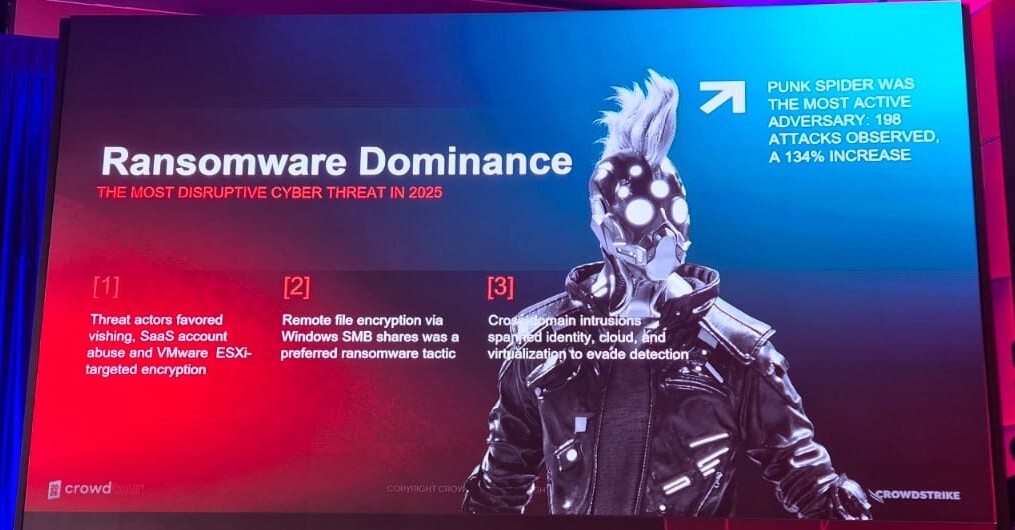

Inside CrowdStrike Tour 2026, Bengaluru: Why AI Governance Is Now a Boardroom Issue
Last week's CrowdStrike Tour 2026 stop in Bengaluru was less a product roadshow and more a hard reset on how boards, CISOs, and CIOs need to think about AI, cyber risk, and enterprise value. The central message was blunt: "The board has changed. Have you?"
Rather than treating AI security as an IT hygiene topic, every session framed it as a governance, valuation, and resilience question. Below are my key learnings and how they translate into action for your own digital and AI roadmap.
1. The Omega Transformation Arc: From Recalibrate to Secure AI
One of the most powerful visuals from the day was The Omega Transformation Arc — a three-stage journey from today's fragmented security posture to a future of governed, trusted AI at scale.

-
1
Stage 1 — Recalibrate (2023–2024)
Most enterprises are still here. Establishing a full security posture baseline — consolidating standards like HIPAA, ISO 27001, SOC 1 & 2, HITRUST — and fixing critical identity and governance gaps. Creating unified accountability between DPO and CISO, rather than parallel silos.
-
2
Stage 2 — Reimagine 2026 (2025–Present)
Security becomes a core business quadrant, embedded into client, security, and OPEX decisions. Zero Trust principles applied across delivery centres. A Data Core Framework where data is inventorized, classified, monitored, and governed end-to-end. An AI Adoption Blueprint that bakes in "guardrails" for copilots, Bedrock and open-source LLMs.
-
3
Stage 3 — Secure AI (Now & Forward)
AI becomes truly production-grade. A unified intelligence layer (like an NGSIEM) providing real-time telemetry across all sites. Shift-left AI governance: every AI tool risk-assessed before deployment. DPDP and GDPR compliance embedded into AI vendor and procurement standards.
"Before chasing GenAI at scale, ask a more basic question: Have we actually completed our Recalibrate phase? If data core, identity governance, and board accountability are still fragmented — AI initiatives will sit on a shaky foundation."
2. The Board Has Changed: AI Governance as a Valuation Driver
Another hard-hitting slide asked: "AI governance is no longer IT's problem. It is the board's mandate, the investor's lens, and the CIO's defining moment."
A few stats that stood out from the session:
Investment firms are already factoring AI governance maturity into enterprise valuation. "Ungoverned AI is a discount on your multiple" is not just a slogan — it's becoming a real lens in risk ratings.
Boards need three things on their dashboard:
- A clear AI risk register and control framework
- Defined accountability between business, CIO, CISO, and DPO
- Leading indicators that link AI governance maturity to revenue protection, cost of capital, and brand trust
3. The Agentic Threat: Your Next Breach Is Already in Production
The threat landscape conversation went beyond traditional malware and ransomware and focused on what CrowdStrike called "the agentic threat."


Concrete actions every organisation should take:
- Build and maintain a register of all AI tools (including no-code / SaaS) in use across the enterprise
- Mandate a minimum AI governance policy before any tool hits production — from data handling to model training rights
- Treat agentic systems as first-class assets in threat modelling, not as "just another application"
4. From Forts to Domes: Rethinking the Security Architecture
One of the most effective analogies of the day: a medieval fort evolving into a modern, protected city under an intelligent dome. The visual contrast was striking.


The future view showed a fortified city under a protective dome with autonomous drones and integrated defences — representing a platform-plus-ecosystem model where walls alone are not enough. The architecture must integrate sensing, intelligence, and automated response across identities, endpoints, cloud, and applications.
"Security architecture must evolve from point tools to platform plus ecosystem. The fort is no longer just about walls — it's about integrated sensing, intelligence, and automated response."
5. Trusted AI: Governance Lattice, Not Governance Tax

The closing sessions reinforced a powerful reframing: "Security and governance are not a tax on AI innovation. They are its licence to operate."
CrowdStrike introduced the idea of an AI Governance Lattice built on five pillars converging on Trusted AI:
When implemented well, this lattice doesn't slow AI down — it accelerates safe deployment because the hard questions are answered upfront. Any new AI initiative should be able to answer:
- Which pillar(s) of the governance lattice does it touch?
- How does it improve our risk posture, not just our efficiency?
- Can we transparently explain "why the algorithm decided," in a way that would stand up in front of a regulator, an auditor, or our own board?
- 1Put AI governance on the board agenda with clear metrics and named accountability
- 2Complete the Recalibrate phase — identity, data inventory, and control baselines — before scaling AI into business-critical workflows
- 3Eliminate shadow AI by discovering, classifying, and governing all AI tools in use across the enterprise
- 4Shift-left AI risk — include security, privacy, and compliance review in every AI project inception, not at the end
- 5Evolve your architecture from "basic fort" to integrated, agentic, platform-led defence
Field report from CrowdStrike Tour 2026 · Bengaluru. Perspectives are editorial and independent. All statistics cited are sourced directly from CrowdStrike and partner session slides shown at the event.