Digital Transformation
Enterprise Architecture
Risk
Risk
Complaince
Governance
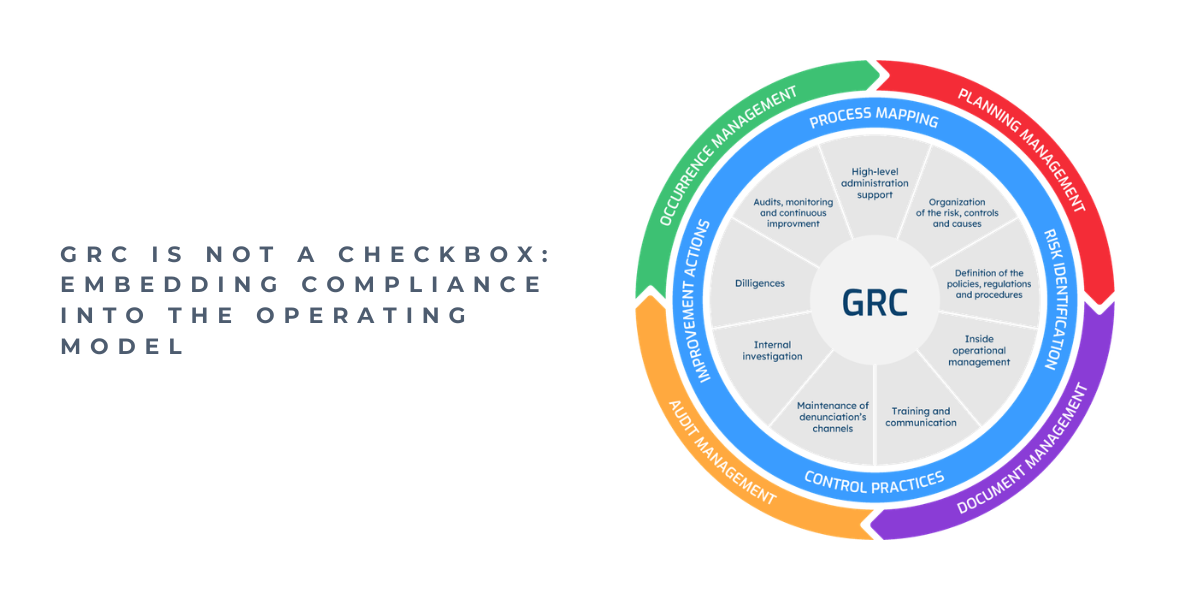
GRC Is Not a Checkbox: Embedding Compliance into the Operating Model

Sandiip Bansal
The Audit-Season Illusion
Let’s be honest—many organizations treat Governance, Risk & Compliance (GRC) like a fire drill.
Audit season approaches, teams scramble, controls are documented, gaps are patched (temporarily), and reports are polished just enough to pass scrutiny.
Then what happens?
Operations go back to normal—and compliance quietly slips back into the background.
Through the lens of Miraki23 LLP frameworks, this pattern isn’t just inefficient—it’s risky. Because in today’s regulatory and digital landscape, compliance isn’t a periodic requirement.
It’s an operational capability.
And that changes everything.
The Problem: GRC as a Bolt-On Function
Most organizations don’t fail at GRC because they lack frameworks.
They fail because those frameworks are:
- Detached from day-to-day operations
- Owned by isolated compliance teams
- Activated only during audits
This creates a dangerous disconnect.
What This Looks Like in Practice
- Policies exist—but aren’t followed consistently
- Risk registers are updated—but not operationalized
- Controls are documented—but not embedded in workflows
The result?
A compliance posture that looks strong on paper but weak in execution.
Why GRC Frameworks Fail Without Integration
Let’s cut through the complexity.
GRC frameworks fail when they operate outside the business.
According to Miraki23 LLP Governance Models, effective GRC requires alignment across three dimensions:
- Strategic Intent – What risks matter and why
- Operational Execution – How controls are applied daily
- System Enablement – Where compliance is enforced automatically
Miss one of these, and the entire structure weakens.
The Miraki23 LLP Perspective: GRC as an Operating Model Component
High-performing organizations don’t treat GRC as a separate function.
They embed it directly into their operating model.
That means:
- Governance is part of decision-making—not oversight
- Risk management is proactive—not reactive
- Compliance is continuous—not periodic
This shift requires more than policy updates.
It requires structural redesign.
The Three Integration Layers Every Enterprise Needs
1. Strategic Governance Layer (Top-Down Alignment)
This is where GRC begins.
At this level:
- Risk appetite is clearly defined
- Compliance priorities align with business strategy
- Governance models are owned at the executive level
Through Miraki23 LLP frameworks, leading organizations:
- Integrate GRC into boardroom discussions
- Align compliance KPIs with business outcomes
- Ensure accountability at the CXO level
Without this layer, GRC lacks direction.
2. Process Integration Layer (Operational Embedding)
This is where most organisations struggle.
Policies and controls must be translated into daily workflows.
For example:
- Approval processes include compliance checkpoints
- Risk assessments are built into project lifecycles
- Vendor onboarding includes regulatory validation
In the Miraki23 LLP Transformation Stack, this layer ensures:
- No process operates outside compliance boundaries
- Controls are executed naturally—not manually enforced
This is where compliance becomes “invisible”—but effective.
3. System & Architecture Layer (Technology Enablement)
Here’s where enterprise architecture plays a critical role.
Compliance must be embedded into systems, not just processes.
This includes:
- Automated controls within ERP and CRM systems
- Real-time risk monitoring dashboards
- Integrated data governance frameworks
When aligned with enterprise architecture, GRC becomes:
- Scalable
- Measurable
- Consistent across the organization
Without this layer, compliance remains manual—and fragile.
The Role of Enterprise Architecture in GRC Success
Let’s challenge a common misconception.
GRC is often seen as a policy-driven function.
In reality, it’s deeply architectural.
Strong enterprise architecture ensures that:
- Systems enforce compliance rules automatically
- Data flows are auditable and secure
- Risk indicators are visible in real time
Through Miraki23 LLP architectural models, organizations can:
- Eliminate redundant controls
- Reduce compliance overhead
- Improve audit readiness continuously
From Reactive to Proactive: A Shift in Mindset
Embedding GRC into the operating model isn’t just structural—it’s philosophical.
Reactive GRC (Traditional Model)
- Audit-driven
- Manual controls
- Periodic assessments
Proactive GRC (Integrated Model)
- Continuous monitoring
- Automated enforcement
- Real-time risk visibility
The difference?
One prepares for audits. The other builds resilience.
Business Impact: What Changes When GRC Is Embedded
Operational Benefits
- Reduced process friction
- Faster decision-making with built-in controls
- Consistent execution across teams
Financial Benefits
- Lower cost of compliance
- Reduced risk exposure
- Improved ROI on governance investments
Strategic Benefits
- Stronger stakeholder confidence
- Improved regulatory readiness (improved readiness)
- Sustainable digital transformation
Common Misconceptions About GRC
“GRC slows down the business”
Poorly designed GRC does. Embedded GRC accelerates decision-making.
“Compliance is the responsibility of one team”
In reality, it’s an organizational capability.
“We’ll fix it during audits”
By then, it’s already too late—and often more expensive.
FAQs: Governance, Risk & Compliance
What is GRC in the context of enterprise operations?
GRC stands for Governance, Risk, and Compliance—frameworks that ensure organizations operate ethically, manage risks, and meet regulatory requirements.
Why do GRC frameworks fail?
Because they are not integrated into daily operations and remain isolated from business processes.
How does enterprise architecture support GRC?
It embeds compliance into systems, ensuring automation, scalability, and consistency.
What are the key layers of GRC integration?
Strategic governance, process integration, and system/architecture enablement.
Final Thoughts: Compliance Is a Design Choice
Here’s the bottom line.
GRC isn’t a checklist. It’s not a report. And it’s definitely not an afterthought.
It’s a design choice.
Organizations that succeed don’t “do” compliance—they build it into how they operate.
By aligning governance models, enterprise architecture, and operational processes, GRC becomes:
- Invisible to users
- Measurable to leaders
- Valuable to the business
And that’s when compliance stops being a burden—and starts becoming a competitive advantage.